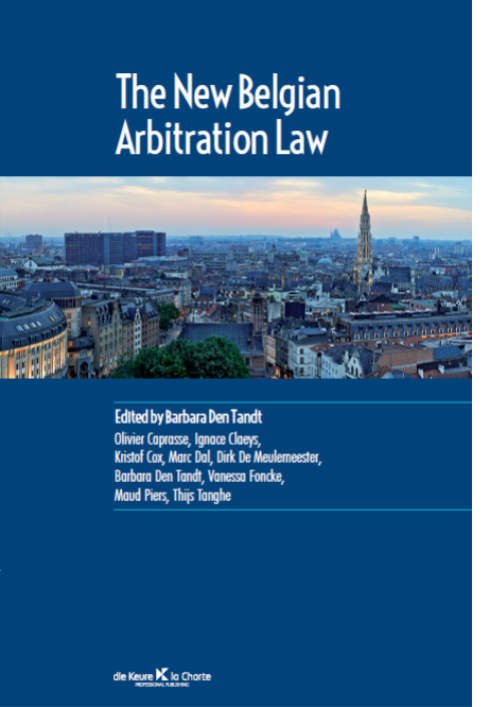
The New Belgian Arbitration Law
As the Belgian Arbitration Act of 24 June 2013 entered into force on 1 September 2013, it seemed appropriate to celebrate the second anniversary of this progressive and modern piece of legislation with a book. This volume is the result of an excellent cooperation of the Institute of Private International Law of KU Leuven and Cepani.
Dispute resolution of all types, raises issues of choice of law and choice of ‘court’ or venue. Parties have to ascertain lex arbitri (the law of the arbitration agreement); the curial law (the procedural law which will guide the arbitration proceedings, despite the latin curia not commonly referred to as lex curia); and the ‘proper law’, the law that governs the actual contract (lex causae. In the case of contractual arrangements, the lex contractus). Current volume reviews important aspects of Belgian law as the curial law. It is a welcome contribution to scholarship, which the Institute of Private International law was most happy to contribute to.
In addition, this volume is welcomed by the arbitration community. Following the introduction of a completely revised Part VI of the Belgian Judicial Code, an in-depth analysis with regard to its wording, structure and underlying mechanisms is required in order to facilitate its correct application. This volume serves exactly that purpose. Renowned Belgian arbitration practitioners and scholars – some of whom were members of the 2008 Working Group that drafted the new law – have contributed and shared their views, insights and experience, covering all aspects of the new arbitration law. Therefore, CEPANI is grateful that the Institute of Private International Law facilitated the come into being of this book.
€49
Auteur(s)
Productspecificaties
Inhoud
Preface
The new Belgian arbitration law
Dirk De Meulemeester and Maud Piers
I. Introduction
II. The concept of arbitration
III. The realization process of the new arbitration law
IV. The objectives behind the new arbitration law: a monistic system with a broad scope of application
V. Summary of the substantive changes
VI. Conclusion
The arbitration agreement
Barbara Den Tandt
I. Introduction
II. The arbitration agreement
L’instance arbitrale selon la nouvelle loi sur l’arbitrage
Olivier Caprasse
I. Introduction
II. Principes
III. Introduction de la procédure
IV. Conduite de la procédure
V. La sentence
VI. Clôture de la procédure
VII. Conclusion
The arbitration procedure: making the difference
Kristof Cox
I. Introduction
II. Thesis: back to the roots!
III. Tips and tricks from the hearing room
IV. Conclusions
Evidence in arbitration under the new Belgian arbitration act
Vanessa Foncke
I. The importance of evidentiary rules in arbitration
II. Party autonomy
III. General powers of the arbitral tribunal in the taking of evidence
IV. Interaction with the courts in the taking of evidence
V. Investigative measures
VI. Conclusion
Arbitration and emergency
Marc Dal
I. The power of the arbitral tribunal to order interim and conservatory measures
II. The emergency arbitrator
III. The fast track arbitration
Annulment of arbitral awards before Belgian courts
Ignace Claeys and Thijs Tanghe
I. Procedural aspects
II. Grounds for annulment
III. Scope and effects of an annulment
IV. To conclude: may arbitrators be held liable for the annulment of an award?
Volledige omschrijving
As the Belgian Arbitration Act of 24 June 2013 entered into force on 1 September 2013, it seemed appropriate to celebrate the second anniversary of this progressive and modern piece of legislation with a book. This volume is the result of an excellent cooperation of the Institute of Private International Law of KU Leuven and Cepani.
Dispute resolution of all types, raises issues of choice of law and choice of ‘court’ or venue. Parties have to ascertain lex arbitri (the law of the arbitration agreement); the curial law (the procedural law which will guide the arbitration proceedings, despite the latin curia not commonly referred to as lex curia); and the ‘proper law’, the law that governs the actual contract (lex causae. In the case of contractual arrangements, the lex contractus). Current volume reviews important aspects of Belgian law as the curial law. It is a welcome contribution to scholarship, which the Institute of Private International law was most happy to contribute to.
In addition, this volume is welcomed by the arbitration community. Following the introduction of a completely revised Part VI of the Belgian Judicial Code, an in-depth analysis with regard to its wording, structure and underlying mechanisms is required in order to facilitate its correct application. This volume serves exactly that purpose. Renowned Belgian arbitration practitioners and scholars – some of whom were members of the 2008 Working Group that drafted the new law – have contributed and shared their views, insights and experience, covering all aspects of the new arbitration law. Therefore, CEPANI is grateful that the Institute of Private International Law facilitated the come into being of this book.

Anderen bekeken ook
Blijf op de hoogte van relevante informatie, recente publicaties en opleidingen.
Schrijf u in op onze nieuwsbrief.
Nieuwsberichten
Blijf op de hoogte van de laatste ontwikkelingen en nieuwe updates.